
When men between 18-25 come into therapy, they don’t usually walk in talking about “pressure.” They talk about feeling stuck. Or behind. Or tired for no clear reason. Some will say they are not as motivated as they used to be. Others will describe getting irritated easily, or switching off from people without really knowing why.
When we take the time to look at what is sitting underneath all of that, there is often a build-up of pressure that has been there for a while, just not spoken about directly.
This stage of life is often portrayed as exciting. People talk about freedom, opportunity, and having your whole future ahead of you. Yet when I sit with men between eighteen and twenty-five in the counselling room, the experience they describe is often very different.
Many do not arrive saying they feel pressured. Instead, they talk about feeling lost, overwhelmed, angry, disconnected, exhausted, or unsure why life feels harder than it should. They wonder why they struggle to relax, why they cannot switch their minds off, or why they feel like everyone else seems to be coping better than they are.
When we begin exploring what is happening beneath the surface, there is often a collection of pressures that have been building quietly for years.
The Pressure to Know What You Are Doing With Your Life
One of the biggest sources of anxiety for young men is the expectation that they should have a clear direction. At eighteen, they are often expected to make decisions that could shape the next decade of their lives. University, apprenticeships, careers, relationships, moving out, travelling, saving money, buying a house, starting a business. The choices seem endless.
At the same time, there is often very little certainty. Many young men feel as though everyone else has a plan while they are still trying to work out who they are. They watch friends getting promotions, buying cars, graduating, getting engaged, or launching businesses, and begin questioning whether they are falling behind. The reality is that very few people have life figured out in their early twenties. Yet uncertainty can feel like failure when everyone around you appears confident.
Psychologically, uncertainty creates stress because the brain prefers predictability. When the future feels unclear, the nervous system often stays on alert, scanning for danger and searching for answers. This can leave young men feeling restless, anxious, and unable to enjoy the present because they are constantly worrying about the future. Many men carry this pressure silently because admitting “I don’t know what I’m doing” can feel vulnerable in a culture that often rewards confidence and certainty.
Financial Pressure and the Weight of Responsibility
For previous generations, adulthood often followed a clearer path. Work hard, find a job, buy a house, settle down. Today’s reality feels very different. Many young men are entering adulthood during a period of rising living costs, expensive housing, student debt, insecure employment, and increasing economic uncertainty.
Some are trying to support themselves while studying. Others are helping parents financially. Some send money abroad to family members. Others feel pressure to become financially successful because they have absorbed messages that their worth as a man is linked to their ability to provide.
The challenge is that many are carrying adult responsibilities while still trying to establish themselves. Money worries do not always show up as conversations about money. They often appear as stress, sleeplessness, irritability, difficulty concentrating, or a constant feeling that there is no room for mistakes. For some men, every decision feels loaded with consequences because there is little financial safety net beneath them.
Relationships, Dating and Modern Masculinity
Relationships can be another significant source of pressure. Many young men want meaningful connections, but they are often trying to navigate a dating world that feels increasingly confusing. They may wonder:
- How confident should I be?
- How vulnerable is too vulnerable?
- Am I attractive enough?
- Am I successful enough?
- What do women actually want?
- Why does dating seem easier for everyone else?
Social media and dating apps can intensify these concerns. Instead of comparing themselves with a handful of people, young men are now comparing themselves with thousands.
There can also be significant anxiety around sex and intimacy. Despite the fact that most people feel uncertain at times, many young men believe they are supposed to know exactly what they are doing.
Few spaces exist where men can openly discuss fears about rejection, loneliness, body image, sexual performance, or emotional vulnerability. As a result, these concerns often remain hidden. What appears externally as confidence can sometimes mask significant insecurity underneath.
The Pressure to Become “The Right Kind of Man”
One question sits beneath many conversations with young men: “What kind of man am I supposed to be?” The challenge is that they often receive conflicting messages. Be strong, but also emotionally intelligent. Be ambitious, but don’t prioritise work too much. Be confident, but not arrogant. Be independent, but emotionally available. Be successful, but stay humble.
Many young men feel caught between traditional expectations of masculinity and newer expectations that sometimes appear to contradict them. This is not necessarily about choosing one model of masculinity over another. It is about trying to build an authentic identity while navigating multiple and often competing messages.
For men who lack strong male role models, this process can feel particularly confusing. When identity is unclear, many begin searching for answers through external markers such as income, status, appearance, popularity, achievements, or social approval. The problem is that these things are often unstable foundations for self-worth.
Constant Comparison Through Social Media
Previous generations compared themselves to neighbours, classmates, or colleagues. Today’s young men compare themselves to the entire internet. Every day they are exposed to people who appear wealthier, fitter, happier, more attractive, more successful, and more confident. They see entrepreneurs making millions before thirty. Fitness influencers with perfect physiques. Couples appearing deeply in love. Friends travelling the world. Athletes, actors, and content creators living extraordinary lives.
What often gets forgotten is that social media presents edited highlights rather than ordinary reality. The human brain was never designed to compare itself against thousands of people every day. Yet many young men wake up and immediately begin measuring their lives against carefully curated images. Over time, this can create a constant sense of inadequacy. No matter how much progress they make, someone online always appears to be doing better.
Family, Culture and Unspoken Expectations
Not all young men experience pressure in the same way. A working-class young man may face different pressures from someone who grew up in a wealthy family. A young man from an immigrant family may carry expectations that differ significantly from those of his peers.
Some young men feel responsible for supporting parents. Others feel pressure to become the first person in their family to attend university. Some are expected to carry cultural traditions forward. Others are trying to balance multiple identities across different communities.
The concept of intersectionality is important here because stress does not exist in a vacuum. Our experiences are shaped by race, class, culture, family structure, education, opportunity, and the wider systems we live within. Many young men are carrying burdens that are invisible to those around them. What appears to be laziness, lack of motivation, or indecision may actually be the result of competing responsibilities and expectations pulling them in different directions.
Having Nowhere To Put What They Are Carrying
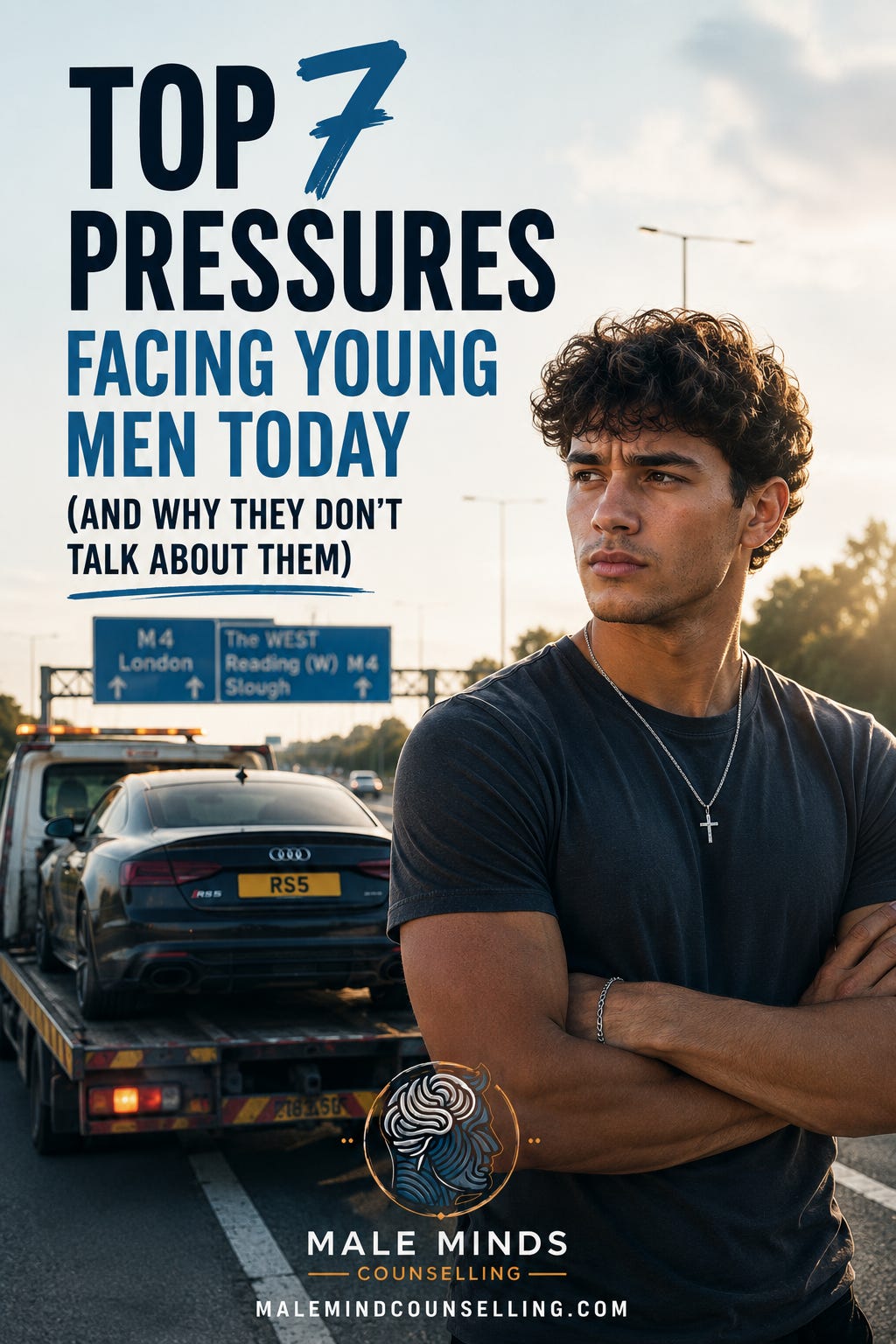
Perhaps the greatest pressure is not any single challenge. It is carrying all of them alone. Many young men have friends. They may have large friendship groups. They may spend time together regularly. But friendship and emotional support are not always the same thing.
A surprising number of men tell me they have never had a conversation where they openly discussed their fears, insecurities, loneliness, sadness, or struggles. Not because they are unwilling. Often because they do not know how. Many have grown up receiving messages such as:
- Deal with it.
- Man up.
- Get on with it.
- Other people have it worse.
- Don’t complain.
- Stay strong.
These messages can encourage resilience in some situations. However, they can also teach men to disconnect from their emotional experience rather than understand it.
The result is that pressure accumulates internally. And when pressure has nowhere to go, it rarely disappears. Instead, it often emerges through anger, irritability, emotional withdrawal, excessive gaming, drinking, workaholism, avoidance, anxiety, low mood, or a sense of emotional numbness. From the outside, it can look like a young man has stopped trying. From the inside, it often feels like he has been carrying too much for too long.
Why Men Often Don’t Talk About These Pressures
One of the biggest misconceptions about young men is that they do not think deeply about these issues. Most do. The challenge is that many have never developed the language to describe what they are experiencing. They know they feel frustrated, exhausted, stuck, disconnected, or overwhelmed. They just do not always connect those feelings to the pressures sitting underneath them.
This is one reason counselling can be valuable. It provides a space where the focus is not on fixing, performing, competing, or appearing strong. Instead, it becomes possible to slow down and make sense of what is happening.
When young men begin recognising these pressures as understandable responses to difficult circumstances rather than personal failures, something often changes. The problem shifts from “What’s wrong with me?” to “What have I been carrying?” That question tends to open the door to a very different conversation.
Counselling for Young Men Aged 18-25 in Reading and Online
If you are a young man between 18 and 25 and feel overwhelmed by pressure, anxiety, low mood, stress, loneliness, relationship difficulties, confidence issues, or uncertainty about the future, counselling can provide a space to talk openly and make sense of what you are carrying.
At Male Minds Counselling, I work with young men across Reading and throughout the UK via online counselling. Many of the men I support are dealing with pressures around university, work, careers, dating, friendships, family expectations, social media comparison, identity, self-esteem, and finding their place in the world.
As an NCPS Accredited Counsellor, I offer a confidential, non-judgemental space where you can explore what is happening beneath the surface. Whether you are struggling with anxiety, depression, anger, overthinking, burnout, low confidence, childhood experiences, trauma, or simply feeling stuck, therapy can help you better understand yourself and develop healthier ways of coping.
Sessions are available online via Zoom or in person in Reading, Berkshire. Evening appointments are available to fit around university, work, apprenticeships, shift patterns, and changing schedules.
Counselling Sessions: £60 per 60-minute session
If you are looking for a counsellor for young men in Reading, an online therapist for men aged 18-25, or support with anxiety, depression, confidence, relationships, stress, or life transitions, Male Minds Counselling provides professional, confidential support tailored to your needs.
For more information or to arrange an initial appointment, visit www.malemindscounselling.com.