
I want to share some thoughts with you about what I have learned and observed, specifically regarding a topic that I think is profoundly destructive yet rarely talked about, which would be humiliation trauma in boys and men. I cannot tell you how many boys and men in Reading and across Berkshire have been humiliated and embarrassed in the various systems they have grown up in, and it has had a massive impact on them. Humiliation is the deep feeling of shame, embarrassment, or loss of pride that occurs when someone is publicly disgraced, belittled, or made to look foolish. It is an intense emotional reaction to a perceived attack on an individual's dignity or social standing. Some people get confused between embarrassment and humiliation. Embarrassment is brief. It’s personal discomfort occurring when your social mask slips - like tripping or misspeaking. Humiliation goes deeper, attacking your dignity or self-image, often publicly, and leaving a lasting wound. Embarrassment is fleeting; humiliation lingers and challenges your sense of self - although, for some, that challenge can evolve into a kink for humility itself.
Humiliation is when you have a bed wetting problem as a child and your parents loudly talk about it to people like you can't hear and without your permission. Embarrassment is when you're twenty five and your parents bring up how you wet the bed when you were eight to your crush. Humiliation is something that is perceived to single you out and isolate you because no one else (supposedly) has the same issue you do. (”Theo doesn’t wet the bed and he’s younger than you, so why do you keep doing this?”). Embarrassment makes you self conscious, but it’s over something that you know happens to other people, the attention brought on you specifically is just uncomfortable (”all kids wet the bed at some point why are you bringing up mine?!”) Another example can be something like: I was embarrassed while telling my wife that I don't necessarily have a bath everyday.....- I felt humiliated when my wife joked about the fact that I don't have a bath everyday in front of her friends.
If you are a young man between the ages of 18 and 35 reading this, or if you are a clinician working with men, or if this applies to someone you care about, I want to welcome you to this deep dive into the impact of abuse and neglect within narcissistic family systems and broader social structures. I am going to unpack the topics of shame and humiliation. To understand how these forces shape male psychology, we have to look at the difference between healthy shame and catastrophic shame, and then map out exactly what humiliation trauma is, why it acts as a silent architect of male suffering, and how you can begin to heal from it.
The Anatomy of Shame: Healthy vs. Catastrophic
To talk about humiliation, we first have to establish a clear understanding of shame. Shame is critical to everything related to trauma and narcissistic abuse, but it is an emotion that is widely misunderstood. We need to differentiate between healthy shame and unhealthy, catastrophic shame.
Healthy shame is a temporary emotion you experience when you violate a social norm. It is a biological signal designed to keep us connected to our tribe. When you do something that crosses a boundary, healthy shame flares up briefly, letting you know you stepped out of line, and then it dissipates as you reconnect with the people around you.
I want to share a concept about how healthy shame is intended to work from Patricia D. Young’s excellent book, Understanding and Treating Chronic Shame. She notes that when a child misbehaves, a parent’s displeasure may bring on a momentary, temporary shame. In that acute moment, there is a brief sense of internal shattering or disintegration. Developmentally, a child will experience that wave of shame intensely, but in a good enough parenting scenario, the disciplinary point returns the child’s self experience to coherence.
What does a disciplinary point mean? It means the child is given words for what happened. The parent helps the child understand: “I did a bad thing, but the moment is over, I repaired it, and I am still a good kid.”
This small break, followed immediately by distress and then a warm repair with the parent, helps a child learn the boundaries of human behavior. It allows you to enter later childhood and adulthood with a functional compass, understanding the difference between doing something bad and being bad. Those early experiences of making a mistake, feeling a brief flash of shame, and then reconnecting safely with your caregiver form the absolute foundation for knowing how to manage your emotions well as an adult.
Narcissistic abuse and neglect do not produce healthy shame. Instead, they produce what I call extreme or catastrophic shame. In a catastrophic shame experience, a person is completely flooded by feelings of absolute inferiority. You feel totally isolated from other people, but you also want to actively avoid them because you expect nothing but contempt from everyone around you. In a moment of acute, catastrophic shame, you do not have any words. There is just a raw sense of disintegrating and falling apart inside. Because this occurs in an abusive or neglectful environment, there is no repair. The relational bridge is broken and left in pieces, leaving the shame stuck inside of you to fester.
The renowned trauma researcher Dr. Judith Herman wrote a brilliant analysis of this. She explains that extreme or catastrophic experiences of shame are a signal of profound relational disruptions or violations, particularly when methods of coercive control are used within the primary attachment relationship. Narcissistic abuse and neglect are, at their core, systematic ways of exerting coercive control over a child. When a developing child is subjected to this, they are overwhelmed with extreme, completely intolerable shame states that alter the trajectory of their emotional development.
Defining Humiliation Trauma
This brings us directly to the concept of humiliation. While shame and humiliation are intimately connected, they are not the same thing. Humiliation occurs when you experience extreme, catastrophic shame in front of somebody who has contempt and disgust for you, and who is often actively abusing or dominating you at that exact time. Humiliation is the experience of being completely exposed and seen while you are in a state of toxic, catastrophic shame.
Think about the mechanics of it. With catastrophic shame, your biological instinct is to disappear, to hide your face, to melt into the floor so no one can look at you. With humiliation, someone is forcing you to be seen. They are deliberately stripping away your privacy and your dignity. If they are humiliating you, they want you to feel this way. They are intentionally establishing a rigid hierarchy where they are powerful, valuable, and dominant, and you are powerless, worthless, and subordinate.
These experiences are amplified exponentially if there are multiple people humiliating you, or if an audience of peers or family members stands by watching while someone degrades you.
Humiliation trauma is a distinct form of psychological injury under the broader umbrella of complex trauma. While almost all complex trauma contains elements of humiliation, humiliation trauma itself refers to the lasting, deeply ingrained negative effects on a person’s mental, emotional, and physical state caused by severe or repeated experiences of being degraded or dehumanized.
Many people associate trauma exclusively with fear-based events, such as being in a car crash, surviving a natural disaster, or experiencing physical violence where you think you are going to die. That is fear-based trauma, which activates our fight or flight systems. Humiliation trauma certainly contains elements of fear because you are trapped in a dangerous relational dynamic, but it goes much deeper than standard fear. It is rooted entirely in an overwhelming, systemic assault on your identity and self worth.
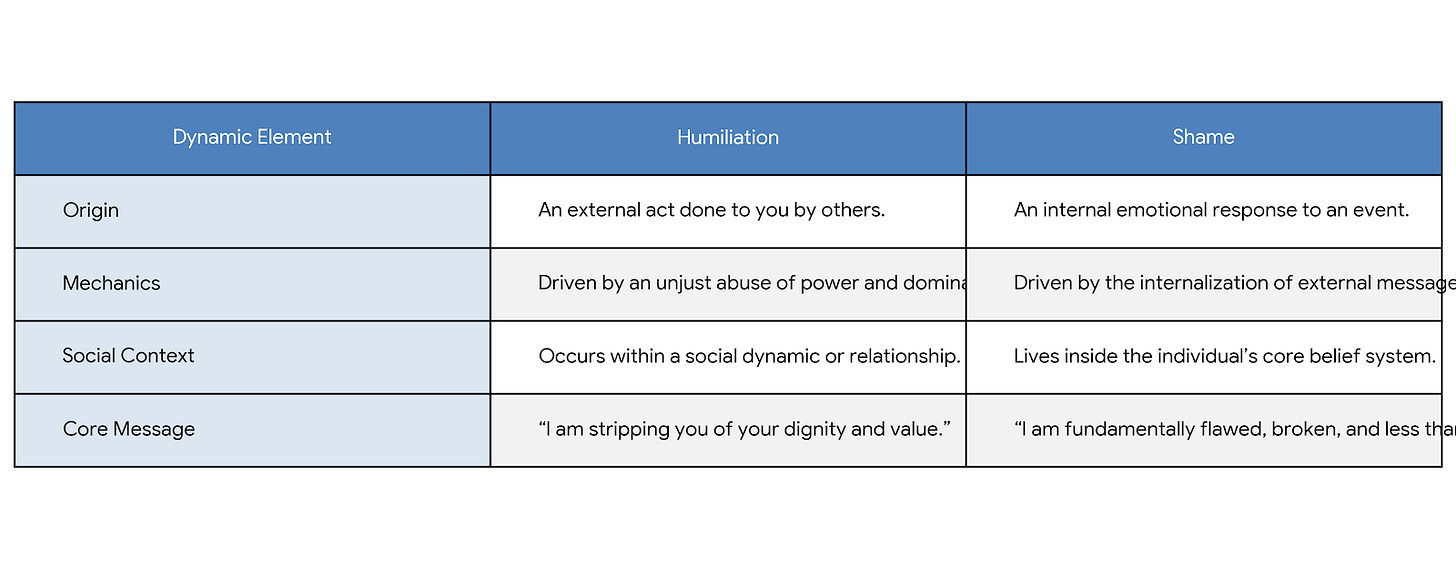
As the table illustrates, a helpful way to look at it is that shame is the process of a boy or man internalizing the humiliation he has suffered. Others use power to make him feel less than, so he internalizes it. Others mock him and tell him he is not good enough, a failure, or a loser, so he takes those external statements, builds a psychological wall out of them, and develops a core shame belief. Humiliation is the weapon actively wielded by an abuser; shame is the chronic internal wound left behind in the victim.
The Methods of Domination
To humiliate someone is to publicly strip them of their dignity, to lower them in the eyes of the collective, and to communicate to them that they are fundamentally devalued. Because power is central to this dynamic, the victim of an act of humiliation can be described not just as feeling humiliated, but as being humiliated. It is an objective reality of victimization. It is a live demonstration of an authority figure using power unjustly with total apparent impunity.
Humiliation trauma does not happen in a vacuum. It requires a social context and an act of domination, typically involving the abuse of authority. For young men, the sources of this trauma can span from early childhood well into early adulthood. Let’s look at the most common environments and methods where this trauma is inflicted:
Harsh Caregiving and Narcissistic Parenting
In a narcissistic family system, a narcissistic parent requires everyone around them to serve as a mirror that reflects their superiority. They have an insatiable need to feel better than everyone else, including their own children. If a son makes a mistake, expresses an independent need, or does something that the parent perceives as making them look bad, the parent will viciously put the child down to restore their own fragile ego.
This often looks like a parent throwing a massive, loud rant in public, screaming at the child, calling them names, and shaming them in front of strangers or family members. The child is left standing there completely exposed, wishing a hole would open up in the ground so they could crawl in and die.
Even more insidiously, some parents routinely use explicit shaming techniques under the guise of discipline. I have heard horrific stories of parents whose child struggled with chronic bedwetting, and out of sheer frustration and a desire to exert control, they forced the child to wear a sign to school that read, “I wet my bed.” They operated under the cruel, mathematically flawed logic that public humiliation would break the habit, completely blind to the reality that they were inflicting a profound psychological injury that would alter that child’s brain chemistry for decades.
Targeted Bullying and Peer Ridicule
This occurs on school playgrounds, in high school hallways, in locker rooms, and now across social media platforms. It involves ongoing, systematic teasing, mockery, and scorn designed specifically to lower a boy’s status in front of his peers. It includes practical jokes that are purposely engineered to be deeply embarrassing, such as pulling a boy’s pants down in public or tricking him into a vulnerable position so a group can laugh at him.
It also extends to relational aggression, like spreading horrific, untrue rumors through a community or group chat where the young man is left completely powerless to defend his reputation.
Violations of Privacy and Physical Integrity
When a person in power intentionally violates your basic human rights, your boundaries, or your personal privacy, it is inherently humiliating. This includes sharing your deeply personal secrets with others after you trusted them with your vulnerability. It includes denying basic physiological needs, such as refusing a child or an employee access to a bathroom, shelter, or food as a form of punishment.
Sexual and Physical Violence
Overwhelming experiences of violence are deeply humiliating. Sexual abuse and physical degradation profoundly violate your bodily autonomy. This type of trauma communicates a brutal, non-verbal message:
“You do not own your own body. You are less than human, your boundaries mean nothing, and you do not deserve basic human rights or safety.”
When physical or sexual violence takes place within a social context where others watch and do nothing, or where the community actively choice to turn a blind eye, the humiliation is amplified to an unbearable degree. The silence of the bystanders signals to the victim that the entire collective agrees with his devalued status.
Whether this trauma comes from an individual, a family system, an organized institution like a church or sports team, or a broader cultural environment like public cancel culture on social media, the core mechanism is always identical. Someone in a position of power or social leverage acts in a way that fundamentally lowers you, strips your dignity, and isolates you below the rest of humanity.
Why Humiliation is the Key to Understanding Men
If we want to truly understand the psychology of young men between 18 and 35, we have to recognize that humiliation is one of the most painful, disruptive emotional experiences a man can face. Its effects linger far beyond the actual moment of the event. For many men, the trauma started when they were boys, yet its fingerprints are completely visible fifty years later in how they run their businesses, interact with their partners, and view themselves in the mirror.
To understand why this is so significant for men specifically, we have to look at the intersection of trauma and traditional male socialization. From a very young age, boys are heavily socialized to associate masculinity with strength, control, self-sufficiency, and social status. They are told to be dominant, to never show weakness, and to protect their honour.
Humiliation is the precise, complete inversion of that ideal. Humiliation forces a man into absolute powerlessness, public vulnerability, and low social status. It is a total castration of his identity. Because our culture gives men very few safe spaces to process feelings of worthlessness without judgment, this trauma gets driven deep into the subconscious, mutating into a wide array of highly destructive coping behaviours and psychological adaptations.
When a young man has experienced chronic humiliation trauma throughout his development, his brain and behavior adapt in several distinct ways:
The Mask of Success and Hyper-Independence
Many men try to running away from their internalized shame by building a flawless, unassailable image of success. They throw themselves entirely into acquiring money, high-status jobs, physical peak performance, and the material perks of society. Subconsciously, they are trying to compile an overwhelming mountain of external evidence to disprove the childhood voice that tells them they are a loser.
Alongside this success comes an intense hyper-independence. They view expressing a basic human need as an act of humiliating weakness. They believe that if they admit they need help, love, or support, they are handing someone a weapon that will inevitably be used to degrade them. So, they suffer in absolute isolation behind a wall of achievement.
Severe Relational Avoidance and Lying
Because vulnerability feels like an extreme, life-threatening risk, men with humiliation trauma often withdraw completely from genuine emotional intimacy. They might have casual relationships, but they will never open up or let their partner see who they truly are. Within a relationship, they find it completely impossible to admit when they are wrong or to accept constructive feedback. They do not hear a partner saying, “Hey, it hurt my feelings when you forgot our plans.” Instead, their trauma translates that feedback as, “You are a failure, you are stupid, and I hold you in contempt.”
To protect themselves from this perceived humiliation, they will deflect, launch into intense defensive anger, or flip the script to blame their partner. If they make a mistake or fail at something, they will weave elaborate webs of lies and cover-ups because facing the truth of a mistake triggers the exact internal shattering they experienced as a child.
The Internal Critic and Deep Self-Hatred
When you are repeatedly humiliated by caregivers or peers, your brain internalizes those external abusers and turns them into a savage, nonstop internal critic. These men live with a brutal inner monologue that tells them they are disgusting, toxic, or fundamentally subhuman. They expect everyone they meet to treat them with contempt the second they discover “who I really am.”
This is an direct echo of a classic narcissistic parenting script. I have sat with so many clients whose parents explicitly told them:
“The only reason your friends like you is because they don’t know the real you. Once they find out what you’re actually like, they will despise you just like we do.”
To tell that to a child is horrific. It completely destroys their ability to accept love, because it teaches them that anyone who is kind to them is simply being fooled. This level of chronic, buried self-hatred frequently drives young men toward severe depression, substance abuse to numb the pain, and pseudo-suicidal ideation or active suicide.
The Cycle of Subconscious Repetition
One of the most tragic paradoxes of complex trauma is our tendency to subconsciously seek out the very environments that broke us. Because chronic humiliation was a young man’s childhood normal, his brain becomes wired to recognize toxic dynamics as familiar and, strangely, safe because they are predictable.
Deep down, his core shame belief tells him that he is worthless and deserves to be degraded. Consequently, he will often gravitate toward partners, friends, or employers who treat him with verbal abuse, disrespect, and contempt.
Conversely, encountering truly healthy, safe, and kind people actually feels terrifying and dangerous to his nervous system. He has no baseline for unconditional kindness. His brain assumes that a safe person’s warmth is simply a calculated setup, a trap designed to lure him into letting his guard down so they can deliver an even more devastating blow of humiliation later on. As a result, he will often actively sabotage healthy relationships and friendships, retreating back to the familiar comfort of his isolation or his abusers.
The Mutation into Cruel Narcissism
When the pain of being humiliated becomes utterly unmanageable, some men choose an aggressive defence mechanism: they become the humiliator. They resolve that they will never be on the bottom of the power hierarchy ever again.
They seek out positions of authority in their careers, families, or communities, and they turn all of their buried rage outward. They actively mock, belittle, and degrade the people under them. Inflicting this pain on others gives them a sick, temporary sense of psychological relief. By forcing someone else to experience the agonizing pain of being less than, they temporarily convince themselves that they are the ones holding all the power. They repeat the exact cycle of narcissistic abuse that destroyed their own childhood.
The Physical Toll: Dorsovagal Shutdown
To fully comprehend the depth of humiliation trauma in men, we must look beyond psychology and examine what this does to the physical body and the nervous system. When humans are faced with danger or threat, our standard survival mechanism is to activate the sympathetic nervous system, shifting us into a fight or flight state. If a parent is screaming at you or a boss is aggressively threatening your job, your body pumps out adrenaline, preparing you to either fight back or run away.
With severe, inescapable humiliation, however, you cannot fight and you cannot run. A child cannot fight their narcissistic parent; a bullied teenager trapped in a school circle cannot easily sprint away without compounding the mockery. When the brain realizes that both fighting and fleeing are completely impossible and will only result in worse degradation, it flips an emergency survival switch. It bypasses fight or flight entirely and drops straight into a dorsovagal shutdown.
Dorsovagal shutdown is a state of freeze, collapse, and profound dissociation. It is governed by the parasympathetic nervous system’s unmyelinated vagus nerve. When a boy or man is actively being humiliated, his nervous system pulls the plug to protect him from emotional overload.
He retreats deeply inside himself. He disconnects from his body, his emotions go completely numb, and his face becomes flat, zombie-like, or almost catatonic. He enters a state of psychological hibernation, watching the event happen from a distance just to survive the sheer, agonizing impact of the shame.
The massive problem with this adaptation is that while it gets you through the immediate crisis, your nervous system gets stuck in this chronic low-power state. Living in a state of unresolved, ongoing dorsovagal collapse exacts a massive somatic toll on the male body.
Because the nervous system is chronically suppressed and holding onto immense quantities of unexpressed trauma and rage, these men develop severe physical symptoms that standard medicine often struggles to explain. They suffer from chronic fatigue syndrome, feeling completely exhausted no matter how much they sleep. Their digestive systems fail because the body is never in a true “rest and digest” state, leading to irritable bowel syndrome, chronic reflux, and severe cramping. They live with intense, constant muscle tension, especially in the jaw, shoulders, and pelvic floor, alongside debilitating tension headaches and chronic pain.
Their bodies are quite literally keeping the score of the dignity that was stripped away from them.
The Pathway to Healing
If you are a young man reading this and your chest is tightening because this maps out your life story, or if you are realizing for the first time why you struggle so intensely with anger, isolation, and relationship sabotage, please take a deep breath. Hearing this material can trigger a lot of buried pain. If you need to stop reading, walk away, and step outside for a few minutes, please do so.
I want you to understand one thing clearly: humiliation trauma is an extreme form of complex trauma, and its wounds run incredibly deep into your mind and your body. Because of that, healing is not going to happen magically overnight, and it is not something you can just fix by reading a self-help book or resolving to “man up” and try harder. It requires deep, intentional, and structured work. The pathway to recovery actually begins by acknowledging the trauma, then process core shame, then build safe boundaries and then somatic reconnection.
Unpack and Process the Core Shame
The first major step is to bring this hidden trauma out of the darkness of your subconscious and into the light. This is best achieved by seeking out professional therapy with a clinician who truly understands complex trauma, narcissistic family dynamics, and somatic experiencing.
You have to courageously look at the core shame beliefs you built as a kid and realize they were never statements of truth about who you are. They were simply the emotional toxic waste passed down to you by broken, abusive people who did not know how to handle their own emptiness. You need to separate what was done to you from your actual identity. You were humiliated, yes, but you are not humiliating. You are not a disgrace; you were simply a child trapped in a disgraceful environment.
Find Safe Connections and Talk
Humiliation thrives in absolute secrecy. It loses its venom when it is spoken aloud to someone who meets you with empathy instead of contempt.
You need to gradually practice finding safe people, whether that is a therapist, a structured support group for men, or a deeply trusted, healthy friend, and begin talking about these experiences. When you share a deeply embarrassing, shameful memory with a safe human being, and they look at you with total acceptance, respect, and care, it creates a powerful corrective emotional experience. It proves to your nervous system that your true self does not warrant disgust, shattering the old narcissistic programming.
Establish Uncompromising Boundaries
Healing requires you to look at your current life and aggressively purge or set rigid boundaries with anyone who continues to feed your humiliation trauma. If you have parents, romantic partners, or friends who still mock you, belittle your achievements, violate your privacy, or treat you with contempt, you have to look them in the eye and say, “I cannot have this behaviour in my life anymore.”
You cannot heal an internal wound while someone is actively sticking a knife back into it. You must protect your personal peace and your dignity with absolute fierceness.
Reconnect with Your Body
Because your nervous system learned to collapse and go numb to survive, part of your recovery must involve body-based, somatic practices to gently wake your system back up out of dorsovagal shutdown.
This can include somatic breathwork, trauma-informed yoga, weightlifting done with mindful awareness of your body’s sensations, or massage therapy to release chronic muscle armouring. You have to teach your body that the danger has passed, that it is safe to feel your feelings again, and that you are fully capable of safely holding your own emotional energy without shattering.
Please be incredibly patient with yourself as you navigate this terrain. The damage was structural, it was systemic, and it took years to build. But these deep, painful wounds absolutely can heal.
When a young man finally breaks through his chronic shame, drops his armour, reclaims his inherent human dignity, and realizes he is completely worthy of love and respect just as he is, it is one of the most profoundly beautiful transformations I have ever witnessed in my entire career. It takes immense courage to face this, but your life, your freedom, and your peace are entirely worth the fight.