
There is something I want to say to the man reading this who owns a business in Reading. Perhaps you are a CEO. Maybe you are an operations director or managing director. Perhaps you run a construction company in Wokingham, a consultancy in central Reading, a technology business in Thames Valley Park, a property business, a restaurant, an agency, a professional services firm, or a company that you started from nothing.
You may employ ten people. Perhaps you employ one hundred. Perhaps you have spent the last fifteen or twenty years building something that you are genuinely proud of. You have worked hard. You have sacrificed. You have probably missed birthdays, holidays, evenings with your children, and weekends that other people were enjoying. You have taken risks that other people were not prepared to take.
You have made payroll when you were worried about whether there would be enough money in the bank. You have sat awake at two o’clock in the morning wondering whether the deal was going to go through. You have dealt with HMRC, suppliers, customers, employees, competitors, banks, investors, and all the other people who suddenly have an opinion about your business when it becomes successful.
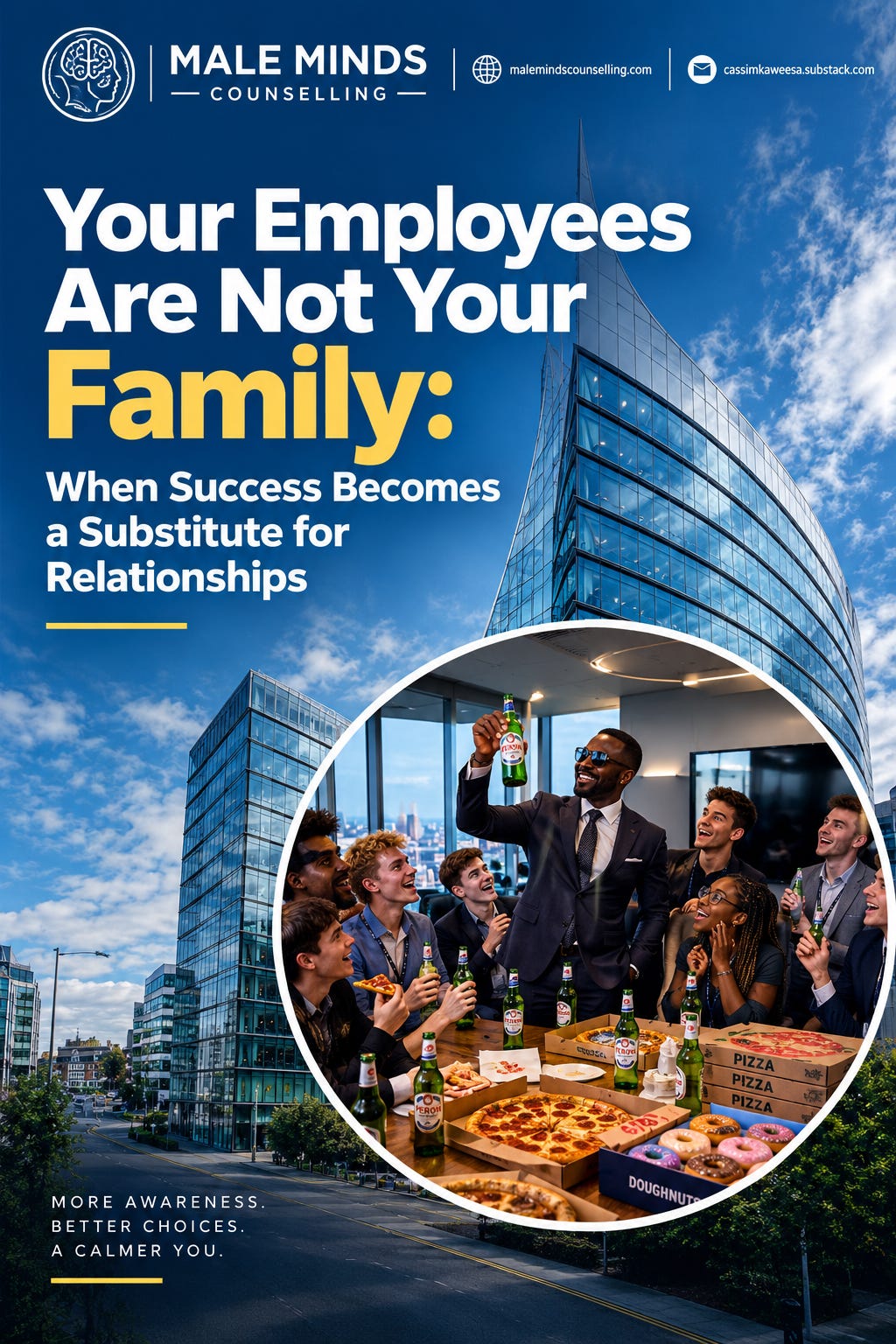
And perhaps, somewhere along the way, something happened. Your business became your family. Your employees became your social circle. Your achievements became your identity. And your ability to control things became your emotional safety. That is where I want to begin, because there is a sentence I sometimes think men need to hear: Your employees are not your family.
They may respect you. They may like you. They may admire you. Some of them may genuinely care about you. Some may even love you in the ordinary human sense in which people can develop affection for one another. But the relationship fundamentally exists within a transaction: you pay them, and they provide labour, skill, time, and responsibility. There is a contract. There is a hierarchy. There are consequences if they stop turning up, and there are consequences if you stop paying them. And that matters, because sometimes successful men confuse being needed with being loved. Sorry to tell you this, but those are not the same thing.
Being Needed Is Not the Same as Being Loved
One of the most uncomfortable things a successful man can discover is that a large number of people may need him without actually knowing him. Your employees may need your company, your clients may need your expertise, your investors may need your performance, your suppliers may need your business, your children may need your financial support, and your partner may need the security that your income provides.
But who knows you? Not what you provide, what you produce, what you earn, what you can organise, or what you can fix.
- Who knows what scares you?
- Who knows what makes you feel ashamed?
- Who knows what you are frightened of losing?
- Who knows what you think about when you cannot sleep?
- Who knows what you wish you could change about yourself?
- Who knows when you feel lonely?
- Who knows when you feel like a fraud?
- Who knows what happens inside you when someone criticizes you?
- Who knows what you need when you are not being useful?
That last question is particularly important: Who are you when you are not useful? Many of my clients have built their entire identity around usefulness: I am the provider. I am the boss. I am the problem solver. I am the one who knows what to do. I am the one who makes the decisions. I am the one everyone comes to. I am the one who provides the money. I am the one who gets things done.
There is nothing inherently wrong with any of those things. The problem begins when those things become the only things that make you feel valuable. Because eventually, life will ask you a question that your bank account cannot answer: Who are you when you cannot perform?
The Client Who Wanted Greatness
I remember working therapeutically with a client who had become extraordinarily focused on achievement. He wanted greatness. He wanted more than average. He wanted excellence. He wanted to build something significant with his life. At first glance, you might look at that and think: What is wrong with ambition? Nothing. Ambition can be wonderful. There is nothing wrong with wanting to build a successful business, wanting financial independence, wanting to become excellent at what you do, or wanting to leave something behind.
But underneath his ambition was something much more painful: he did not really believe he was worthy. And because he did not believe he was worthy, he kept trying to produce evidence that he was:
- More money.
- More status.
- More achievement.
- More recognition.
- More responsibility.
- More success.
- More, and more, and more.
The finish line kept moving. Whenever he achieved something, he immediately created another target. Whenever he reached one level, he created another level. Whenever he accomplished something impressive, it stopped being impressive almost immediately. The achievement became normal, then the next achievement became necessary, and then the next one.
This is one of the traps that highly ambitious men can fall into: you think you are chasing success, but sometimes you are actually running away from inadequacy. And if that is what is happening, there is no amount of success that will ever be enough.
When You Start Managing Your Family Like Employees
The problem became even more obvious when we looked at his relationships. He had children, but his relationship with his children was breaking down. He wanted their respect, expected them to listen to him, expected them to behave in certain ways, and expected them to appreciate everything he had provided. From his perspective, there was a certain logic to it: Look at everything I have done for you. Look at the house. Look at the opportunities. Look at the education. Look at the holidays. Look at the things I have bought you. Look at what I have sacrificed. Why don’t you respect me?
But there was something missing: connection. He had confused provision with connection, treating his children as though they were employees: I provide, you perform. I give, you respect. I sacrifice, you comply.
Children do not work like that. Neither do marriages, friendships, or intimate relationships. You cannot build a relationship simply by providing resources. You can build security, opportunity, and comfort, but you cannot purchase intimacy. You cannot invoice somebody for closeness, and you cannot put love on a spreadsheet.
This is where some successful men become trapped. They have spent years becoming extremely good at transactions: negotiating, persuading, selling, managing, delegating, measuring performance, creating incentives, and solving problems. Then they take those skills home. Suddenly, their marriage becomes a performance review, their children become underperforming employees, their friendships become networking opportunities, and their social life becomes another extension of their professional life. Eventually, they discover something devastating: they may have built an extraordinarily successful life while simultaneously building a deeply lonely one.
The Limits of Transaction
Think about the things you can buy: a house, a car, a watch, a holiday, a meal, a business, a qualification, a hotel room, a seat on a plane, a membership, a service, a product. Money is extraordinarily powerful because it gives us access to things. But there are things money cannot directly purchase:
- You cannot buy somebody genuinely wanting to sit beside you.
- You cannot buy somebody missing you when you are gone.
- You cannot buy your child’s admiration.
- You cannot buy your wife’s emotional safety.
- You cannot buy your friend’s loyalty.
- You cannot buy somebody knowing you deeply.
- You cannot buy somebody looking at you when you are at your worst and saying, “I still want you here.”
Those things have to be cultivated. Cultivation is different from acquisition:
- You acquire a car; you cultivate a relationship.
- You purchase a house; you build a home.
- You buy a meal; you share an experience.
- You can purchase someone’s time professionally; you cannot purchase their heart.
Respect Is Not the Highest Human Need
There is something else I want to challenge, particularly among men. We talk constantly about respect, command respect, earn respect, demand respect, never let anyone disrespect you, build something so impressive that people have no choice but to respect you.
What happens if respect becomes the highest emotional currency in your life? You may end up surrounded by people who respect you but do not know you. I would argue that there are experiences far more intimate than respect:
- To be loved.
- To be wanted.
- To be understood.
- To be accepted.
- To be seen.
- To be heard.
- To feel safe.
- To feel that you can fail without being abandoned.
- To be able to say, “I am struggling,” without worrying that your status will disappear.
- To be able to say, “I don’t know.”
- To be able to say, “I was wrong.”
- To be able to say, “I need you.”
Those are not signs of weakness; they are signs that you are human.
The Research Says Something Similar
This is not simply a philosophical argument. The Harvard Study of Adult Development, which has followed people across generations for decades, has repeatedly highlighted the importance of relationships to health and wellbeing. Relationship satisfaction has been highlighted as one of the strongest predictors of a healthy and satisfying later life. Think about that for a moment: not your turnover, not the size of your office, not the number of people who report to you, not the car you drive, nor your LinkedIn following, relationships.
This does not mean your business is unimportant; it means your business is only one part of your life. Global health organisations, including the World Health Organization, recognize that work and mental health are deeply connected, highlighting organizational conditions, manager training, and individual support as crucial components of healthier workplaces.
There is also a fascinating lesson in workplace research: organizational studies on engagement consistently emphasize the importance of the relationship between managers and employees. Leaders and team managers substantially influence team engagement, while employees thrive when feeling known, supported, and developed rather than simply paid.
This does not mean you need to become best friends with your employees; in fact, you should not confuse leadership with friendship. You are still their employer. You still have responsibilities, boundaries, performance conversations, and difficult decisions. Sometimes you will have to dismiss someone, challenge someone, or say no. But you can do those things while still recognizing that there is a human being sitting opposite you, and perhaps more importantly, recognizing that you are also a human being sitting in the other chair.
What Happens When You Build a Life Around Control?
The client I worked with had become extraordinarily good at controlling his environment, but control had become his emotional defense:
- If something threatened him, he removed it.
- If somebody disagreed with him, he distanced himself.
- If a relationship became difficult, he withdrew.
- If someone did not fit the vision he had for his life, he cut them off.
- If something could not be controlled, he tried to control it anyway.
This can look like strength from the outside: you are decisive, have standards, do not tolerate nonsense, know what you want, remain focused and disciplined, and do not allow people to waste your time. But sometimes there is another story underneath:
- Sometimes control is fear wearing a suit.
- Sometimes perfectionism is shame wearing a Rolex.
- Sometimes relentless ambition is insecurity with a business plan.
- Sometimes emotional distance is abandonment dressed up as independence.
- Sometimes “I don’t need anyone” really means: “I am terrified that if I need somebody, they will eventually leave me.”
That is the sort of thing therapy can help you explore, not because there is something wrong with you, that you are broken, or that successful men need to be “fixed,” but because you may have become exceptionally skilled at surviving while never learning how to feel safe enough to live.
Therapy Is Not About Making You Less Ambitious
This is particularly important for men reading this who may think therapy is going to turn them into somebody who sits around talking about their feelings all day. That is not what therapy needs to be. Therapy can be a place where you examine the operating system underneath your behavior:
- Why do you need to win?
- Why is losing so painful?
- Why does criticism feel like humiliation?
- Why does disagreement feel like disrespect?
- Why do you struggle to delegate?
- Why do you become angry when people do things differently from you?
- Why do you find it difficult to trust?
- Why does your partner saying “I need more from you emotionally” make you want to work harder rather than become more emotionally available?
- Why do you feel more comfortable solving someone’s problem than sitting beside them while they are hurting?
- Why is it easier to buy your child something than spend an uninterrupted hour listening to them?
- Why can you negotiate a £500,000 contract but cannot tell your wife that you are frightened?
These are vital questions, and therapy gives you somewhere to explore them.
The CEO Who Never Gets to Be a Man
There is a particular danger for men at the top: the higher you climb, the fewer people there are who can challenge you. Employees may not tell you what they really think, colleagues may be careful around you, and people may agree with you because you have the authority to make decisions. Your family may also adapt themselves around your moods. Gradually, without anybody deliberately intending it, you can create an environment where everyone tells you what you want to hear.
That is dangerous, because leadership requires information, and emotional isolation deprives you of information. Your employees might know that you are intimidating, your wife might know that you are emotionally absent, your children might know that they avoid you, and your friends might know that you only talk about business, and you might be the last person to know.
Therapy can become one of the few places where you do not have to be the CEO. You do not have to impress your therapist, perform, or have the answer. You can walk into the room and say, “I don’t know what is happening to me.” For a man whose entire identity has been built around knowing what to do, that sentence can be extraordinarily powerful.
There Is Beauty in the Ordinary
I want to return to something that ambitious men sometimes forget: there is beauty in an ordinary life. There is nothing inherently wrong with being ordinary, nothing shameful about having an ordinary Tuesday evening, nothing unsuccessful about sitting in the garden with your partner, nothing unambitious about watching television with your children, nothing pathetic about going for a walk without turning it into a networking opportunity, nothing wrong with having dinner with a friend and talking absolute nonsense, nothing wrong with cooking, being bored, resting, or doing something that produces absolutely no financial return.
If everything in your life must produce a return, eventually you will turn your entire existence into a business. And you are not a business, you are a person. Your wife is not an asset, your children are not investments, your friendships are not networking opportunities, your employees are not your family, and your life is not a balance sheet.
The Problem With Always Moving the Goalposts
If you cannot appreciate the ordinary, the extraordinary will eventually become ordinary too:
- You buy the house, then you want the bigger house.
- You buy the car, then you want the better car.
- You reach £100,000, then you want £250,000.
- You reach £1 million, then you want £5 million.
- You become managing director, then you want to become CEO.
- You become CEO, then you want to own the company.
- You own the company, then you want another company.
There is nothing wrong with growth, but if every achievement immediately becomes insufficient, you need to ask yourself a difficult question: What are you actually trying to feel? Because perhaps the next achievement is not going to give you the feeling you think it will. Perhaps the thing you are looking for cannot be achieved, perhaps it can only be experienced: connection, belonging, peace, intimacy, acceptance, love, meaning.
Your Business Does Not Have to Become Your Identity
If you are a business owner in Reading, I am not asking you to care less about your business. I am asking you to make sure your business does not become the only place where you feel valuable. Have somewhere else to belong. Have people who know you outside of your job. Have friendships where nobody cares about your turnover. Have relationships where you are not the person who solves everything. Have somewhere you can go where you do not have to be impressive.
And perhaps most importantly: learn to tolerate being ordinary. There is a strange paradox here: the more comfortable you become with being an ordinary human being, the less desperately you need to prove that you are extraordinary. When you no longer need to prove your worth constantly, you may actually become a better leader:
- You may listen differently.
- You may delegate differently.
- You may respond differently when somebody makes a mistake.
- You may stop interpreting disagreement as disrespect.
- You may become more curious and less defensive.
- You may become capable of apologising and saying, “I was wrong.”
Your employees may not love you, they do not have to, as they are employees, but they may trust you. They may feel psychologically safer around you, feel respected, and feel that you see them as human beings rather than simply resources. That is a much healthier foundation for leadership.
Perhaps the Question Is Not “Do They Respect Me?”
So if you are reading this as a CEO, entrepreneur, operations director, manager, or business owner, perhaps there is a different question worth asking yourself. Not “Do my employees respect me?”, but try: “Do the people closest to me actually know me?”
- Do your children know you?
- Does your partner know you?
- Do your friends know you?
- Can you tell someone that you are frightened?
- Can you tell someone that you are lonely?
- Can you admit that you do not know what you are doing?
- Can you sit with someone else’s pain without immediately trying to solve it?
- Can you receive love without earning it?
- Can you rest without feeling guilty?
- Can you experience a day that produces nothing and still believe that you have value?
Listen, that may be the work: not becoming less successful, less ambitious, abandoning your business, or giving away everything you have built, but learning that your achievements are things you have done, not the totality of who you are.
You are a CEO, but you are also a man. You are an entrepreneur, but you are also a father, perhaps a husband, perhaps a son, perhaps a brother, perhaps a friend. You are an operations director, but you are also somebody who gets frightened, who gets hurt, who needs affection, who wants to be wanted, who wants to be understood, and who, underneath all the titles and achievements, probably wants the same thing most human beings want: to feel that they are enough.
That is the conversation worth having in therapy. Because eventually, every successful man has to confront the same question: If I stopped achieving tomorrow, would I still believe that I was worthy of love? That is a very different question from whether you are successful, and sometimes, it is a much more important one.
Counselling for CEOs, Directors and Business Owners in Reading
If you are a CEO, managing director, operations director, entrepreneur, founder or business owner in Reading or the wider Berkshire area, and you have started to question what your success is costing you personally, counselling can provide a confidential space to step outside your professional role and examine what is happening underneath the surface.
Perhaps your business has become your identity. Perhaps you struggle to switch off from work, find it difficult to delegate, feel responsible for everything, or become frustrated when people do not perform to your standards. Perhaps you have achieved the financial success you once wanted but still feel restless, lonely or unable to enjoy it.
You may recognise yourself in questions such as:
- Why can’t I switch off from work?
- Why do I become so angry when people make mistakes?
- Why does criticism feel like a personal attack?
- Why do I find it difficult to trust people?
- Why do I feel responsible for everything?
- Why can’t I delegate?
- Why does my partner say I am emotionally unavailable?
- Why do I find it easier to provide for my family than talk to them?
- Why do I feel guilty when I am not working?
- Who am I if I am not achieving something?
- Why do I have everything I thought I wanted but still feel dissatisfied?
- Can I be ambitious without allowing work to consume my life?
These are not questions about whether you are a successful businessman. They are questions about what success means to you and what role it has come to play in your emotional life.
Therapy for High Achieving Men
At Male Minds Counselling, counselling for successful men is not about asking you to become less ambitious, abandon your business or stop caring about achievement. It can instead provide somewhere to explore the psychological patterns underneath your ambition. This might include:
- Work stress and chronic pressure
- CEO and executive stress
- Burnout and emotional exhaustion
- Workaholism and difficulty switching off
- Perfectionism and fear of failure
- Anger and irritability
- Control and difficulty delegating
- Leadership pressure
- Imposter feelings
- Relationship difficulties
- Emotional intimacy
- Loneliness
- Fatherhood and family relationships
- Identity and self worth
- Fear of failure
- Fear of losing status or success
- Difficulty asking for help
- Difficulty expressing vulnerability
- The psychological impact of running a business
You may be exceptionally good at solving problems for everyone else. Counselling provides somewhere where you do not have to solve the problem immediately.
Counselling for Business Owners in Reading and Berkshire
Male Minds Counselling works with boys and men in Reading, Wokingham, Woodley, Earley, Lower Earley, Caversham, Tilehurst, Shinfield, Theale and surrounding Berkshire areas, with online and in person counselling available.
If you are a business owner, CEO, director or senior leader, you may have very few places where you can speak completely openly. Employees cannot necessarily be the people you process your emotions with. Business partners may have their own interests. Friends may know the successful version of you. Your family may experience the consequences of your stress without necessarily understanding where it comes from.
Counselling can provide a confidential space where you can put the professional identity down for an hour and ask:
What is actually happening to me? You do not need to be experiencing a breakdown. You do not need to have a mental health diagnosis. You do not need to have lost your business, marriage or family. Sometimes counselling begins much earlier, when a successful man simply notices: “Something isn’t right, and I don’t want to wait until it gets worse.”
Your business can be important without becoming your entire identity. You can be ambitious without being consumed by achievement. You can lead people without needing them to validate you. You can provide for your family without confusing provision with emotional connection. And you can build something extraordinary without forgetting that you are a person outside of what you produce.
If you are a CEO, director, entrepreneur, founder, managing director or business owner in Reading or Berkshire and you would like a confidential space to explore stress, achievement, relationships, identity, emotional wellbeing or the pressures of leadership, Male Minds Counselling can provide that space.
Male Minds Counselling
Counselling and psychotherapy for boys and men in Reading and Berkshire. For business owners, entrepreneurs, CEOs, directors and senior professionals. Online and in person
- counselling for CEOs Reading
- counselling for directors Reading
- therapy for business owners Reading
- therapy for entrepreneurs Reading
- counselling for entrepreneurs Reading
- executive counselling Reading
- executive therapy Reading
- CEO mental health Reading
- business owner mental health Reading
- men’s counselling Reading
- counselling for successful men
- counselling for high achieving men
- therapy for high achievers Reading
- work stress counselling Reading
- burnout counselling Reading
- workaholic counselling Reading
- stress management for business owners
- leadership stress counselling
- executive stress counselling
- entrepreneur burnout
- business owner burnout
- male therapist Reading
- men’s mental health Berkshire
- counselling Berkshire
- psychotherapy Reading
- counselling Reading Berkshire